When I first read Christian Astrology, I was surprised that Lilly described the minor aspects and occasionally used them in horary charts. Following Lilly’s example, I paid attention to minor aspects and often found them useful, especially when they were partile or close to exact. A good example of Lilly’s use comes from Christian Astrology, pages 389-390. Here is the chart as Lilly presented it:
Woman asks Lilly whether she will be able to marry the man she desires. The question was asked on 21 June 1646 (Gregorian) at 10:39:41 AM LMT in London.
The question was asked on a Jupiter day during a Moon hour. Lilly notes in his figure that the hour had just changed from Mercury to the Moon, which he records as the hours belonging to Mercury and the Moon, probably because of his uncertainty about the exact moment of the change from one hour lord to the next. He also notes that the Moon is separating from a square to Jupiter and applying to a trine with Mercury.
Virgo rises, so Mercury rules the querent. Pisces on the 7th cusp means that Jupiter signifies the man she wants to marry. Jupiter lies Cancer, where he is exalted, and Jupiter has just been in a perfect sextile with Venus, which suggests to Lilly that the man is rather full of himself and has recently been “tampering” with another woman.
Fortunately, Venus (the other woman) is separating from Jupiter, and in the strong angular 10th house there is an applying semi-sextile from Mercury Rx (the querent) to Jupiter (the man she desires). This applying semi-sextile gives Lilly hope that there are still “some sparks of love betwixt them.”
Lilly then notes that the Moon is separating from Jupiter (the man) and applying to Mercury (the querent), a significant translation of light connecting the main significators, indicating that the marriage will take place.
Unfortunately, Lilly’s ephemeris did not have accurate positions, so his argument falls apart. Here is the modern chart for the same question:
Note in the modern chart that the Moon is separating from Jupiter, as in Lilly’s original chart, but the Moon is not applying to Mercury SD but rather is separating, so no translation of light is happening at the time of the question. In addition, Mercury is stationary Direct, so that Mercury is separating from the semi-sextile to Jupiter.
How can we explain the positive outcome, since Lilly’s arguments fall apart when we use the accurate values of the positions of the planets? I believe the answer lies in the partile semi-sextile between Mercury and Venus.
Mercury signifies the querent, and Venus is the ruler of the Pisces 7th cusp (the man) by exaltation. Mercury and Venus occupy favorable houses (10 and 9), and Mercury is almost exactly semi-sextile Venus, which applies to trine the Ascendant and sextile the 7th cusp.
In addition, Mercury has just stationed direct and applies to the semi-sextile with Venus, which will perfect by transit within a few weeks of the question. The Moon is separating from Venus (exalted ruler of the 7th of marriage) and the next lunar aspect is a trine to the favorably positioned Sun in the 10th. The Sun is also dispositor of the North Lunar Node in the 11th of hopes and wishes.
Recently I participated in a discussion in an online forum about Robert Zoller’s use of the “modern” planets. This discussion grew out of comments made by Ben Dykes in a 2020 Astrology Podcast commemorating Robert Zoller in which Dykes stated that, as a student of Zoller, he was taught to remove outer planets and asteroids from his astrology charts and to use only the seven traditional planets:
“ ‘What am I really doing astrology for when I can’t rely on some of these things [the outer planets and asteroids] as crutches?’… ‘If I don’t have, let’s say, these outer planets or asteroids and if I’m taking things out of the chart and making it look cleaner and simpler, I’m starting to ask myself what kinds of explanations do I have for what’s happening in the chart?’ So we start to realize and reexamine, what are the tools that we have been relying on and how can we strengthen them and enrich them with traditional concepts, and also in a sense, cleanse ourselves of some addictions that we might have as astrologers. So having more points in the chart does not mean more wisdom, could be another way to put it. So he’s forcing you to rely on wisdom and deeper concepts instead of larding up the chart with points. That was one of the very first things that happened, and it was a really good education and way of reexamining how I thought about astrology.”
The characterization of the outer planets as “crutches” and “addictions” in the above comments, I believe, does not present a full picture of Zoller’s view or use of the modern planets, which clearly evolved over time. I first met Bob in the 1980s at an astrology conference and we spent time chatting about his interest in ancient Latin texts and his efforts to translate Bonatti. Bob was a student of Zoltan Mason in NYC, and it was Mason who introduced him to the work of Morin de Villefranche and encouraged him to read the traditional astrological texts in their original languages. Bob’s study of Morinus profoundly influenced his approach to delineating charts, and he endlessly repeated aphorisms from Morin’s tome, especially from Book 21.
Morinus, who had such a profound influence on Zoller’s thinking, discarded much of traditional astrology as superstitious nonsense. Morin rid his astrology of decans, faces, terms, traditional triplicity rulers (he developed his own system), profections (annual, monthly and daily), and the use of universal signifiers as particular indicators in charts. Zoller, in contrast, worked hard to retrieve and restore what Morinus had thrown in the garbage. Morin, of course, was unaware of the outer planets. Most likely he would have incorporated them into his astrology, probably in the same way he used fixed stars, if he found empirical evidence of their effectiveness.
Interestingly, Zoltan Mason, who was Bob’s teacher, regularly used the outer planets Uranus, Neptune and Pluto as co-rulers, respectively, of the signs Aquarius, Pisces and Scorpio. Zoller himself, in his 1981 book Tools and Techniques of the Medieval Astrologers, followed Mason’s lead and combined the use of both the traditional and the trans-Saturnian planets in his experimentation with medieval techniques, mostly those of Bonatti who had learned them from Latin translations of Abu Ma’Shar. Unfortunately, Bob had miscalculated the angles and cusps of his natal chart, which he used extensively in his experimentation with the medieval techniques. His Asc and MC in the 1981 text are almost a degree earlier than the correct values, so his predictions using primary directions are off by about 10 months.
In presenting the length of life technique described by Bonatti, Zoller concludes that his length of life. based on the seven traditional planets, is likely to be about 82 years, but because of the influence of Uranus, Neptune and Pluto in his chart, he would need to shorten it to 72 years. Bob was impressed that the 72 years, as calculated using both the traditional and modern planets, agreed with the length of life indicated by the method of William Benham in his book The Laws of Scientific Hand Analysis. In fact, Zoller died at age 72, just one day before his 73rd birthday anniversary. One has to wonder what role the power of suggestion played in his demise.
Robert Zoller’s birth chart cast for 7:59 AM EST in Mount Vernon, Westchester, NY. In his 1981 text, Zoller mistakenly cast the chart for Sullivan County, NY, which give an Ascendant of 11 Pisces 13′, and he used the incorrect earlier Ascendant degree in his calculation of continuous profections, thus introducing a timing error of about 10 months. He regarded Pluto in the Placidus 6th house as being determined, as Morin would say, toward illness because of its placement in the 6th. He also stated that the profected Asc at age 2, being at 11 Taurus 13′ in his original calculation of his chart, was square to Pluto in the 6th, correlating with his serious illness just before he turned 2 years of age and his spending his 2nd birthday in an iron lung in the hospital. With the correct chart, the square of the profected ASC to natal Pluto at age 2 is even more exact.
Regarding Zoller’s evolving view of the use of the “modern planets,” Bob said the following in a 2006 interview with Garry Phillipson (italics mine):
“So, the bottom line is, you can do whatever you want to do, and you’ll probably do best following your own opinion and your own light. But my light on this situation in astrology, what I have tried to do, has been to give myself a firm foundation in medieval astrological techniques (which I see as being superior to either Greek or Babylonian astrology or to New-Age astrology) and then make whatever adaptations I feel I have to make to those techniques, such as the inclusion of the use of the modern planets.”
Recently I’ve been thinking a lot about medical horary charts and I decided to re-read Ganivet’s Amicus Medicorum. Lynn Thorndike, in History of Magic and Experimental Science, vol. 4 (1934), 134, states that in “the field of astrological medicine, probably the most influential treatise composed in Europe during the fifteenth century was the Friend of Physicians (Amicus medicorum) written by Jean Ganivet in 1431.” Unfortunately, I have been unable to find an English translation of this text and have had to plod through it in Latin.
Although it was first written in 1431, Ganivet’s text was first printed in 1496 and then reprinted in 1508, 1550, 1596, and 1614. In his text, Ganivet discusses three medical charts for illnesses, dated respectively, 24 August 1418, 29 June 1420, and 7 August 1431. The August 1432 chart is cast to determine whether or not the dean of Vienne would regain his health. I’m not sure whether he was treating it as a horary or a decumbiture chart. The question was asked by the sick Dean through the agency of his physician.
“The text is divided into four sections,, differentiae, each with seven chapters. The first presents the basic structure of the heavens—the number of heavenly spheres and their movers. The second discusses the zodiacal constellations and the primum mobile, the dignities of the planets, their accidental virtues, and detriments. The third differentia presents the causes of plague and death. He illustrates this section with three horoscopes for sicknesses on different dates: 24 August 1418, 29 June 1420, and 7 August 1431. The last example was a horoscope cast to determine whether or not the dean of Vienne would regain his health or die. Ganivet had been asked by Henry Amicus of Brussels to predict the outcome of the dean’s illness.”
Here is Ganivet’s original version of the chart for the Dean of Vienne’s question about the outcome of his illness:
Will I, the Dean of Vienne, survive my illness? Mars day, Hour of the Sun. This horary appears to be cast with Alcabitius Houses.
Here is a modern approximation of the chart calculated with Solar Fire software.
Will I, the Dean of Vienne, survive my illness? Cast in Solar Fire with modern planets and true lunar nodes. Ganivet did not mention that on August 8th, a day after the horary question, the 12th-ruler Sun (also the hour-ruler of the horary chart) would undergo a Solar Eclipse in the 12th house in square to 8th-ruler Mars in Leo. This certainly seems like another testimony of a bad outcome of his illness.
Doctor Henricus Amici asked Ganivet to cast chart to answer the question on behalf of the Dean of Vienne, whether he would survive his current illness. Ganivet cast the chart for Vienne, the location of the sick doctor. I do not know know whether Ganivet was also in Vienne at the time.
Ganivet describes how he came to cast the chart: “Doctor in Medicina, vocatus Henricus Amici, natus de Bruxella in Brabantia petiuit pro Domino Decano Viennense actu infirmo , quæstionem, quid de infirmitate , eius sanitas vel mors: cuius quæstionis hora talis incidit super-Viennen, cœli figura et ordo Planetarum.” (“Doctor of Medicine Henry Amici, born in Bruxela in Brabantia, asked on behalf of the Dean of Vienne, who was currently infirm, a question, ‘what [would be the outcome] of his sickness, recovery or death?’; at the hour [time] of his question there occurred in the sky over Vienne the figure and arrangement of the planets.”)
Ganivet studied the chart and “dedi ascendente et Lunam infirmo, & vidi Lunam euntem ad coniunctionem Solis, infra radios Solis: hocfuit unum testimonium mortis.”
(“I assigned the Ascendant and the Moon to the sick one, and I saw the Moon going to a conjunction with the Sun, under the rays of the Sun; this was one testimony of death.“)
Having first studied the significators of the sick person, Ganivet goes on to study three Lots, or Parts, that are important in questions about life and death. These Lots, probably taken from Bonatti’s works, are:
– the Lot of the Killing Planet (Pars Planetae Interficientis) — the arc by day from the Lord of the Ascendant to the Moon (reversed at night), projected from the ASC. In this chart with Virgo rising, the arc from Mercury to the Moon, projected from the ASC.
-the Lot of Death (Pars Mortis) — the arc, by day or night, from the Moon to the 8th house cusp, projected from the position of Saturn.
– the Lot of Life (Pars Vitae) — the arc by day from Jupiter to Saturn (reversed at night), projected from the ASC.
As Ganivet explains: “Consideraui partem Planetæ interficientis in 14. grad. Leonis inter Lunam, & Solem, & infra radios Solis in principio domus 12. esse signum mali aegra u antis infirmum. Consideraui tertio, partem mortis in 26. grad. Virgin, in ascenden, in domo vitæ malum testimonium. Consideraui quartò partem vitæ præsentis figuræ in 26. gradibus Arietis in domo mortis : ita quod est quædam mala combinatio ; vita seu pars vitæ in domo mortis, & pars mortis in domo vitæ: & uniformiter in cosimili numero graduum signorum Arietis, & Virginis in 26. utriusq; eorum, qui gradus sunt termini maloru, Saturni, & Martis.”
(“I regarded the Part of the Killing or Destroying Planet, in the 14th degree of Leo between the Moon and the Sun, and under the rays of the Sun, at the beginning of the 12th House, an indication of the evil the patient was headed toward. Thirdly, I considered the Part of Death in the 26th degree of Virgo, in the ascendant in the House of Life, a bad testimony. Fourthly, I considered the Part of Life in the present figure in the 26th degree of Aries in the House of Death, a certain bad combination: life or the Part of Life in the House of Death, and the Part of Death in the House of Life; and uniformly in a similar number of degrees in Aries and Virgo, in the 26th degree, which are degrees within the terms of the malefics, Saturn and Mars.”)
He continues, “Confideraui ulterius ad propositum malorum signorum, seu significatione parte fortunæ in 7.grad. Virginis, 6. grad. completi , & 9. minut. in domo 12. quæ omnia dicta sunt testimonia mali : ex quibus signis & testimoniis malis iudicaui mortem ægri futuram in brevi ex eadem infirmitate.”
(“Furthermore, I considered the implications of the evil indications, or the signification of the Part of Fortune in the 7th degree of Virgo, 6 complete degree and in minutes of arc, in the 12th house, that all that has been said are evil testimonies: from which indications and testimonies I judged the death of the infirm person to come in the near future from the same infirmity.“)
Ganivet next considers the fact that Mercury is about to turn Retrograde, essentially on the Ascendant degree. His ephemeris must have differed some from modern values. Here is the ephemeris generated by Solar Fire. The horary chart was cast on August 7th, and Mercury turned Rx about 4 days later. It is noteworthy that the true lunar nodes (which Ganivet was unaware of) made a station on August 8th, one day after the horary chart was cast. This nodal station occurred the same day as a solar eclipse, which Ganivet did not mention. The solar eclipse conjoined the horary 12th-ruler Sun in the 12th house and squared horary Mars, ruler of the horary 8th. Mars in the horary chart is also “at the bendings” in square to the lunar nodes, a configuration which Ptolemy linked to illness and bodily ailments.
Ganivet continus: “Cæterùm aspexi Mercurium dominum ascendentis prope ascendent. ad unum grad. in domo 12. in fine suæ directionis venientem ad principium retrogradationis, & corrumpentem ascenden. & ex hoc iudicaui ægrum venire ad phrenefim, ad tardius infra diem naturalem, licet esset quamplurimú prudens : &ita evenit de phrenefi, & citius ante diem naturalem, & mors post duos dies, & infra duos dies.”
(“For the remainder [of my judgment] I looked at Mercury, Lord of the Ascendant, near to the Ascendant within one degree, in the 12th House, in the end of its direction coming to the beginning of its Retrogradation and corrupting the Ascendant, and from this I judged that the sick person would become delirious within one natural day, although we may [now] be very sensible: and it so happened that regarding the delirium in less than one natural day, and death occurred two days later but within two days.“) He has in mind that Mercury will soon station Rx on the degree of the Ascendant of the horary chart. According to Solar Fire, Mercury stationed Rx on August 11, 1431, at 11:06 AM — four days after the horary question was asked. The Dean of Vienne passed away less than two days after August 7, 1431, at 7:20 AM, probably in the early morning hours of August 9, 1431.
Will I survive my current infirmity?, asked by the Dean of Vienne through the agency of his doctor.
NOTE:
Google Books has links to two versions of Ganivet’s texts:
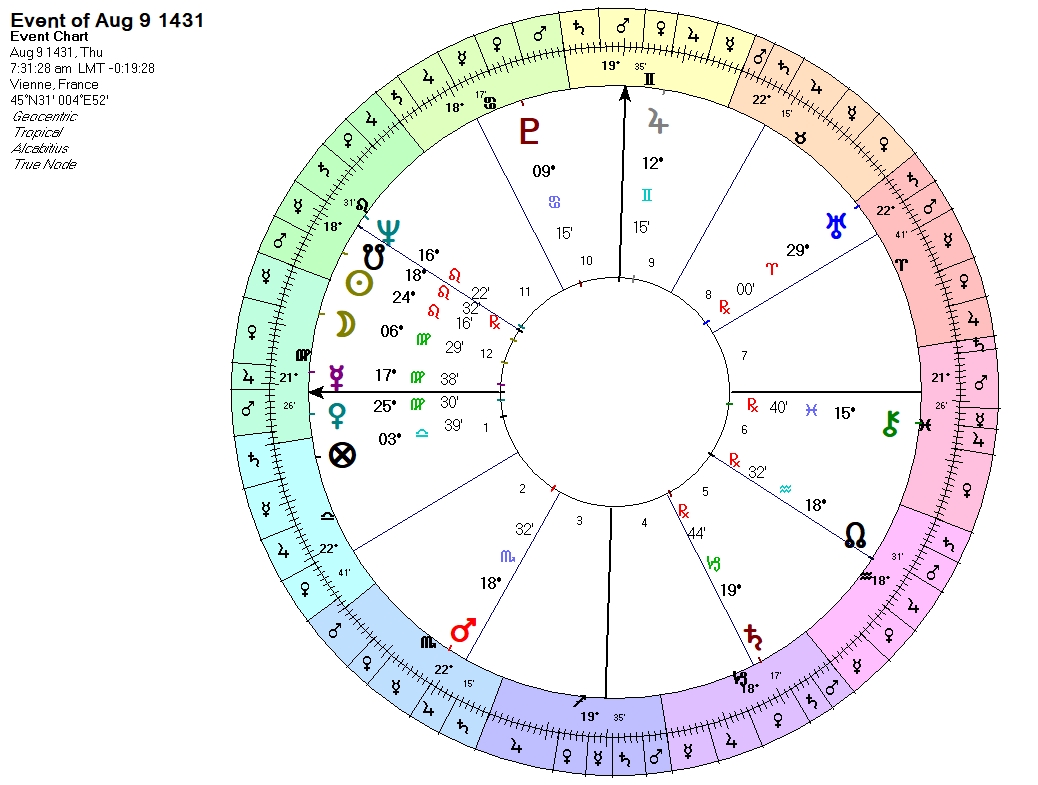
Here is a chart cast for two days after the horary question was asked. It is set for 7:31:28 AM LMT (almost exactly 48 hours after the question) and is noteworthy because that is the moment at which the South Lunar True Node conjoined the 12th cusp and was in partile square to Mars, ruler of the 8th house.
Chart cast for 2 days after the Dean asked his question. In this Chart, the South Lunar True Node conjoins the 12th cusp and is in partile square to Mars, ruler of the 8th cusp, placing 8th-ruler Mars exactly “at the bendings” close to the moment of the Dean’s passing.
Many times the positions of two planets are quite close on the ecliptic circle. Astrologers may regard such planets as being “conjunct” but, in the 9th century, Abu Ma’Shar made the distinction that the two planets within orb of each other’s bodies could only be considered genuinely conjunct if they occupied the same zodiacal sign. Otherwise, such planets were regarded as merely “mixing their natures” in a weak way (see Dykes, Abu Ma’Shar’s Great Introduction, p.446). According to Ma’Shar, conjunctions require that the planets involved inhabit the same sign. In addition, according to Ma’Shar, astrological aspects (planets viewing each other) are a sign-to-sign property. From this perspective, there can be no genuine out-of-sign conjunctions.
Ma’Shar was introduced to astrology by al-Kindi and was drawing upon the Hellenistic literature in his Great Introduction. The Hellenistic astrologers focused on sign-to-sign aspects. Manilius, around 15 CE in his Astronomica, ridiculed the view of his contemporaries that two planets at the extreme ends of signs, which were in aspect, should be considered to share the same aspect as the signs they occupied. For example, Manilius thought it was absurb to regard planet A at 00 Aries 00′ and planet B at 29 Cancer 59′ 59″ to be in a square relationship because the sign Aries lies in square to the sign Cancer but 0 Aries is essentially 120 degrees away from 29 Cancer 59′ 59″ (a trine).
One has to wonder whether Ma’Shar was simply repeating what he read in the Hellensitic texts without testing it against empirical evidence. In addition, the ability to precisely locate a planet within a sign was not as sophisticated as it is in the modern era with its fancy telescopes. Even the position of the starting degree of the zodiac (0 Aries) was a matter of debate. Thus, an apparent conjunction of two planets at the boundary between signs could have been inaccurately considered to be either a genuine conjunction or an out-of-sign coupling of the planets, depending on where you guessed the zodiac circle began (the 0 Aries point). Even if he had tested the theoretical stance empirically, his results may have been based on inaccurate information.
Abu Ma’Shar does not appear to be in agreement with Masha’allah who preceded Ma’Shar by several decades. In a footnote on page 16 of Dyke’s translation ofthe Works of Sahl & Masha’allah, Dykes notes that Sahl, who cites Masha’allah as his source, “allows out-of-sign conjunctions. But he does not allow out-of-sign aspects.” This idea appears to be based on the distinction between conjunctions (bodily connections between planets) and Ptolemaic aspects (the light of one planet connecting with the body of another planet). The nature of such aspects depends upon the sign-to-sign aspect that exists between the signs in which the planets in question reside. In other words, the actual bodies of two planets connecting is a distinct form of contact from the light of one planet touching the body of another.
An analogy may make Ma’Shar’s concept clearer. From Ma’Shar’s perspective, a conjunction is like two lovers getting together in the same bed (zodiac sign). The connection wouldn’t be as powerful if the lovers were physically very close but separated by a door or a wall (the sign boundary). An aspect simply means that one planet can view another planet situated in a different sign. Since planets can see into entire signs at certain angles (Ptolemaic aspects) from their location, it doesn’t matter where in the sign the lover sits, so long as the planet can observe the entire sign occupied by the lover.
Modern astrologers who use midpoints have found that the midpoints of out-of-sign conjunctions are quite powerful even though the planets occupy different signs. I was reminded of this fact recently while reading the new edition of Erin Sullivan’s Where in the World, Astro*Carto*Graphy and Relocation, which I had read many years ago when it first came out. Sullivan presents the case of a man with an out-of-sign Saturn-Uranus conjunction in the 10th house of his birth chart. I have reconstructed the chart from the description in her book.
Birth chart of a man with a Saturn-Uranus out-of-sign conjunction in the natal 10th house.
At birth, Saturn and Uranus are quite close but in different signs. Ma’Shar would view them as “mixing their natures” but in a weak way. In contrast, modern astrologers might view this as a powerful conjunction, despite the fact that Saturn lies in Taurus and Uranus in Gemini. Since the joining of these two planets lies in the 10th house, one would expect to see their combined influence in this man’s career. In fact, he worked as an officer in the Merchant Navy in command of crews of sailors from various nations who worked to deliver goods by ship around the world.
The natal Saturn/Uranus midpoint lies at 29 Taurus 08′, which is about 20 degrees of zodiac longitude (about 20.5 degree of Right Ascension) to the east of his MC/IC axis. Thus, the Saturn/Uranus midpoint lies on the MC/IC line passing through the southern tip of Africa at 020.5 E in waters in the vicinity of Cape Town (at about 018.5 E).
This man reported that on a voyage around the southern tip of Africa he was in charge of a resistant and disgruntled crew that threatened mutiny as they were rounding the Cape. To avoid being murdered by the crew, he needed to escape the ship and seek refuge in Cape Town, where he received harsh treatment from the Apartheid government of that era. This incident is symbolically consistent with the activation of the Saturn-Uranus out-of-sign conjunction in the 10th, which in this case does not appear to have a “weak” effect of the mixing of natures. Here is the man’s natal chart relocated to a position slightly to the west of Cape Town, near the site of the threatened mutiny.
Birth Chart relocated to slightly west of Cape Town. The threatened mutiny and risk of being murdered occurred in waters off the southern tip of Africa near Cape Town.
In the birth chart relocated to the rough position of the ship slightly to the west of Cape Town, we see the out-of-sign Saturn-Uranus “conjunction” on the MC in a paran (mundane square) with Chiron rising on the Ascendant. Chiron is the “wounded healer” and often appears active when there is danger of physical injury. In this man’s chart, Chiron becomes quite powerful in South Africa.
Ebertin associated Saturn/Uranus with states of great tension, rebelliousness, and the potential for violence. Ruth Brummund of the Hamburg School gives keywords for Sa/Ur, which include surprising problems, sudden obstacles, revolutionary tendencies, crises, unanticipated partings or separations, and so on. In this chart, I would be reluctant to say the the out-of-sign connection of Saturn and Uranus had only a weak effect.
In December of 2023 Llewellyn published my book on the predictive techniques of British astrologer William Frankland. I continue to work with Frankland’s methods and find them quite amazing. Recently a colleague was studying the chart of actor Paul Newman and asked whether I had analyzed it for indications of the early demise of his son. I recalled doing sone many years ago but had not looked at Newman’s chart recently.
The incident in question was the death of his son Scott (born 23 September 1950 in Cleveland, Ohio) by an accidental overdose in Los Angeles at 1:07 AM on 20 November 1978. The young man had suffered a motorcycle accident in the fall of that year and was taking painkillers to relieve the consequent discomfort. Police ruled the death to be accidental. Could this type of event have been foreseen in his father’s birth chart?
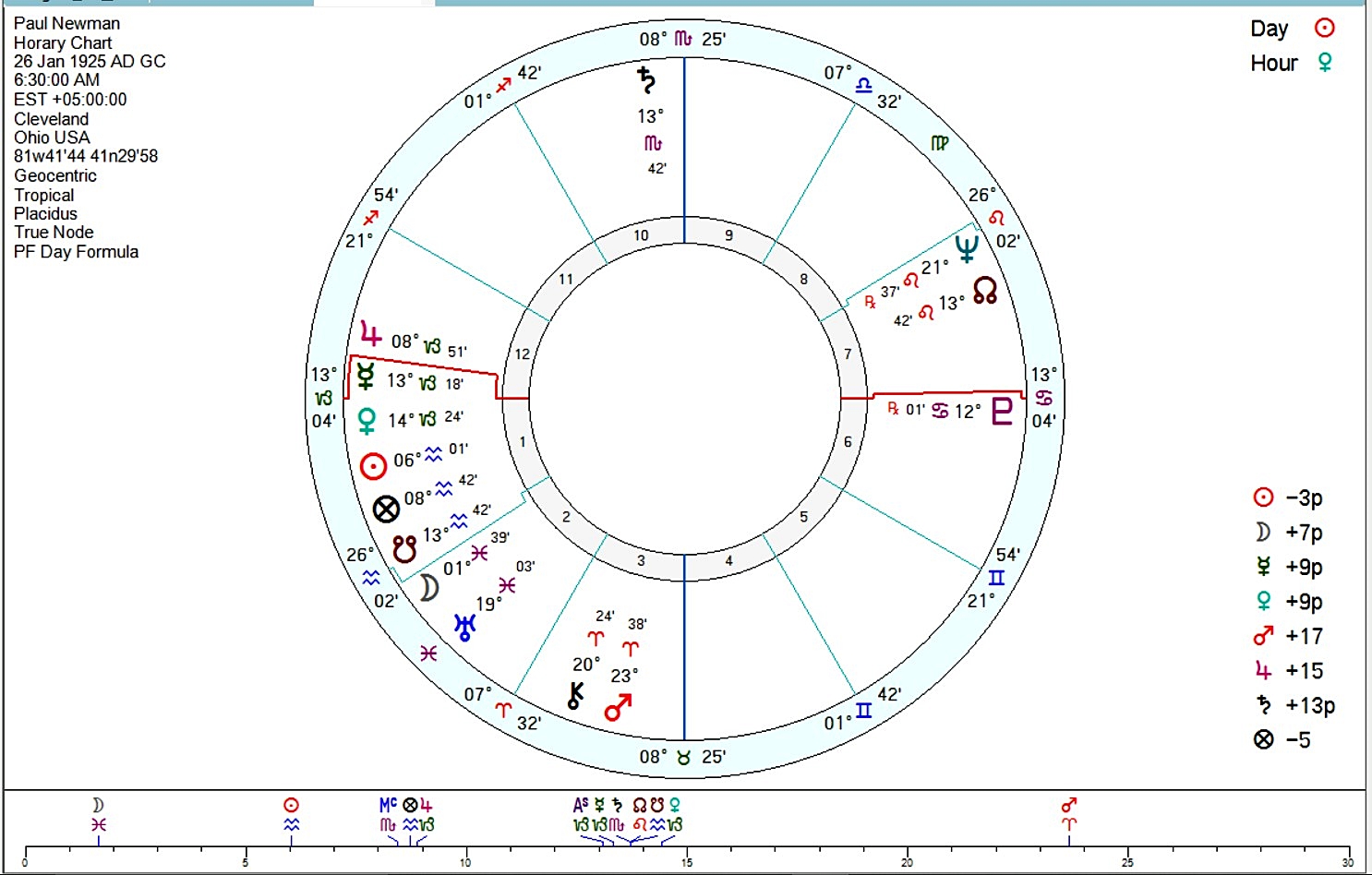
Paul Newman Natal Chart
Paul Newman was born on Monday 26 January 1925, a Sun day until sunrise, during a Venus hour. It is a nocturnal chart, so Saturn is the contrary-to-sect malefic.
At the passing of his son on 20 November 1978, Paul was 53.82 years old. William Frankland converted the age of the native to degrees at the rate of 1 year equals 1 degree. He then projected this result from 0 Aries to arrive at the native’s “age along the zodiac.” How would Frankland have applied this technique to Paul Newman’s chart.
In Newman’s case, the arc of 53.82 degrees measured from 0 Aries, converts to 23 Taurus 49′ in the 4th house of his birth chart. This point’s dispositor is Venus at 14 Capricorn 24′ in the 1st house, conjunct the Asc and Mercury. This point is also being squared by Neptune in Leo in the 7th, but near the cusp of the 8th house. Newman’s local space Neptune line passes through Los Angeles, California, as do his Pluto-Chiron and Pluto-Mercury Parans lines. Natal Saturn in Scorpio in the 10th is in wide opposition to this “age point.”
Seeing Saturn almost half-way through Scorpio, Frankland would have estimated the influence of its opposition to be most operative around age 52 or 53 because, in Alan Leo’s technique, Scorpio corresponds to ages 49 to 56.
Studying the chart, Frankland would have noticed that Jupiter at 8 Capricorn 51 in its fall in the 12th house was almost exactly sesquisquare the “age point” (23 Taurus 48′) in November of 1978, and therefore the significations of Jupiter were likely to manifest around that time. Jupiter is a mixed bag in this chart, being strong and within 5 degrees of the Ascendant, but in its fall and ruling the natal 12th of loss and sorrow, and disposed by Saturn, which is peregrine and in square to the lunar nodes (at the bendings). In addition, Jupiter, as ruler of the natal 12th, also rules the derived 8th of the 5th house of children.
Saturn opposing the “age point” around 52 to 53 years of age is problematic. Saturn is powerful in the angular 10th house but it is peregrine, in square to the lunar nodes, and disposed by a powerful Mars in Aries. Mars rules and occupies the natal 3rd, which is the derived 12th of the 4th of endings. The “age point” occupies the 4th at this time, so that 4th house significations are involved.
This dispositor of the age point, Venus, conjoins both the Ascendant (Newman personally) and Mercury (ruler of the 5th of children, 6th of illness, and 8th of mortality). The harmful planet Saturn in Scorpio in the 10th closely sextiles the Asc, Mercury and Venus, which is again a mixed bag because the intense harmfulness of Saturn is softened only somewhat by the gentle sextile aspect. Mercury, ruler of the 5th, lies in the same numerical degree as the Moon’s nodes, which Barbara Watters called a “fateful” degree.
Putting all these factors together, Frankland is likely to have cautioned that this period of life (ages 52 – 53) are likely to be quite stressful regarding family, children, and ill health with the possibility of the loss through death of a family member.
Getting a general sense of the terrain from these symbolic techniques, the astrologer can then apply other methods such as profections, distributions, solar returns, progressions, directions, transits, and so on to further elucidate how the symbolic directions are likely to work out. For example, in this chart, at age 53 Newman is in a Gemini Ascendant profection year. Gemini rules the cusps of the 5th (children) and 6th ( infirmities) houses. The Lord of the Year is Mercury on the Ascendant being hit by a sectile from malefic Saturn in the 10th. The hour lord at birth is Venus, so the Lord of the Orb at age 53 is Jupiter, which lies in its fall in the 12th and rules the 12th (the derived 8th of his 5th house son). And so on.
This morning I woke to the news that the Francis Scott Key Bridge of Baltimore had collapsed after being hit by a cargo ship. The news was shocking but not surprising. Critics have been pointing out the problems with American infrastructure and warning of impending bridge collapses nationwide for decades, only to be repeatedly ignored by the members of Congress and the Executive branch. Not far from where I live, shortly after midnight on June 28, 1983, a section of the MianusRiver Bridge on I-95 collapsed. That was 40 years ago and should have served as a warning to American politicians, but it did not.
In addition, yesterday was a lunar eclipse day, and many astrologers were expecting some major bad news to mark the period surrounding this eclipse. I assumed that the eclipse of March 25th would show up prominently in a chart cast for the Baltimore bridge collapse.
A timeline of the crash, collapse and initial response
1:24 a.m.: The ship’s lights turn off.
1:25 a.m.: The ship’s lights turn back on.
1:25 a.m.: Dark black smoke starts billowing from ship’s chimney.
1:26 a.m. The ship appears to turn.
1:26 a.m. The ship’s lights turn off again.
1:27 a.m. The ship’s lights turn back on.
1:28 a.m. The ship crashes into the Francis Scott Key Bridge.
1:28:43 a.m. The bridge collapses.
1:40 a.m.: The 911 center dispatches calls to the Baltimore City Fire Department (BCFD) for reports of water rescue in the Patapsco River, according to Baltimore Fire Chief James Wallace. As units were responding, fire officials started receiving calls of multiple people in the water.
1:50 a.m.: The first fire unit arrives on the scene and reports a complete collapse of Key Bridge, Wallace said. The fire department was given information that there were “likely multiple people on the bridge,” who were now in the water, Wallace said.
——————-
Here is the chart for 1:28:43 AM EDT, the time reported for the collapse of the bridge.
As expected, the 25 March 2024 Lunar Eclipse at 5 Libra 13′ lies in the 9th house (long distance travel) near the MC and opposes the Sun at 6 Aries 02′ at the time of the accident. In addition, the MC of this chart, 10 Libra 42′, is very close to the position of the Solar Eclipse of this eclipse cycle, which will occur on 2 October 2024 at 10 Libra 04′. Using the chart animate feature of Solar Fire, I calculated that the MC reached 10 Libra 04′ at about 1:26:27 AM, very close to the time that the ship crashed into the bridge.
Although NBC gives 1:28 AM as the time of the crash, CNN reports: “The US Coast Guard (USCG) is responding to the Francis Scott Key Bridge emergency after receiving a report that a container ship hit it at 1:27 a.m. ET “and it subsequently collapsed,” according to a public affairs officer Kimberly Reaves of the Coast Guard’s 5th District.” The CNN report is quite consistent with 1:26:27 AM EDT, as suggested by the chart.
Another striking feature of this chart is that the DSC at 20 Gemini 19′ is almost exactly the same value as the ASC of Evangeline Adam’s Gemini rising chart for the USA. This makes sense because the port of Baltimore has a major impact on the entire nation.
My own preference for a symbolic USA chart has Gemini rising, with Mercury as the ASC-ruler. In the bridge collapse chart, Mercury lies at 24 Aries 28′ in exact square to the position of Mercury in my preferred USA Gemini rising chart. Here are the two charts superimposed:
Symbolic USA Gemini rising chart with Baltimore bridge collapse superimposed.
Note how the ASC of the bridge accident opposes the USA natal Mars and quincunxes the Bridge Collapse Uranus. The USA natal Mercury in the 3rd house of transportation exactly squares the bridge collapse Mercury at the cusp of the USA 12th house.
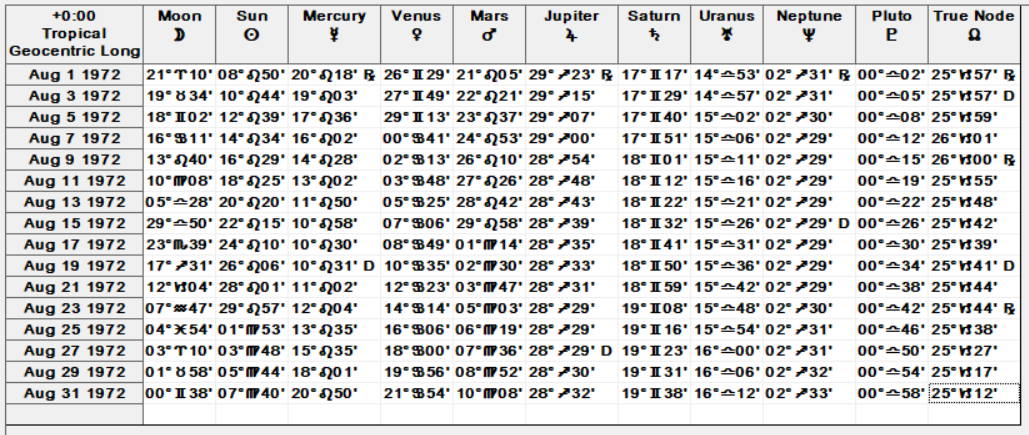
Addendum (27 March 2024): I’ve had a hard time finding when construction of the bridge began. An article from the the Baltimore Evening Sun, dated 10 June 1972, states that the Coast Guard issued a permit for the project on June 9, 1972, which permitted the construction to begin. Other sources indicate that the construction started in August of 1972. The date of another article suggests that construction probably began prior to August 24, 1972: “Substructure under Estimate for Baltimore Harbor Bridge.” Engineering News-Record, 24 Aug. 1972, p. 16. Here is the ephemeris for August 1972, so we can see where the planets were when the building of the bridge began:
Comparing these values to the “collapse” chart (26 March 2024), we see that the Aug 1972 nodal axis fell on the 2nd-8th cuspal axis of the accident. Uranus of 1972 lies directly on the nodal axis of the colapse chart. Saturn of 1972 stationed direct very close to the DSC of the accident chart. Neptune of 1972 stationed direct at 2 Sag 29′, almost exactly opposite Mars of the accident chart.
A reader of this blog sent the following request: _____________________
From: Erkan GÖZÜBÜYÜKOĞULLARI 25 March 2024
Hi Anthony, I have found that secondary progression, where the angles are directed to the average daily rate, produces good results in solar return. Is it possible for you to give an example of this method? _____________________
The idea of progressing the solar return has a long history. Cardan, for example, commented that Alcabitius recommended assigning individual degrees to one day, or slightly more. Morin in Book 23 wrote: “in the annual revolutions of the Sun, the mean daily motion of the Sun is made the measure of each day of that year” (p.111, Holden trans.). Morin has in mind the average daily motion of the Sun in Right Ascension along the Equator. In other words, a rate of 0.98564 degrees per day (360 degrees divided by 365.24 days per year), or 00d 59m 3.33s per day (0 degrees 59 minutes 8.33 seconds per day).
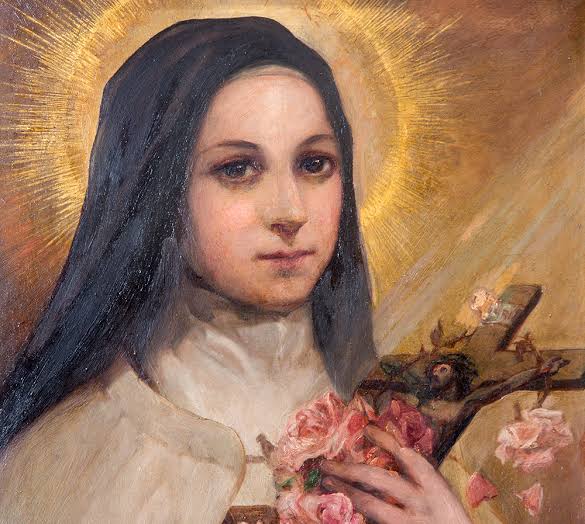
Let’s look at an example. Several saints of the Catholic Church have well-documented birth times, and the dates of their canonization are known. I find that the canonization of a saint routinely shows up prominently in the solar return.
Saint Therese of Lisieu was born on 2 January 1873 at 23:30 LMT in Alençon, France, 48n26, 000e05 (Rodden Rating AA).
Saint Therese, natal chart (Rodden Rating AA) Born on a JUPITER day during a VENUS hour.
Saint Therese has 3 Libra 46′ rising, making hour-ruler Venus also her Ascendant-ruler. Venus occupies Aquarius in the 5th and trines Mars in Libra in the 1st House. Interestingly, Saint Therese is strongly associated with roses, symbolized perhaps by Mars in Libra in the 1st House. Catholics often refer to her as “the little flower of Jesus.” Apparently, before her death of tuberculosis at age 24, Therese promised, “I will let fall a shower of roses from the heavens; I will spend my heaven doing good upon earth.”
She suffered during her life from severe obsessive-compulsive disorder, perhaps indicated by Pluto Rx in Taurus in the 8th in quincunx to Mars in Libra in the 1st and in square to Asc-ruler Venus in Aquarius in the 5th. Mars also applies to square natal Saturn. Natal Jupiter, ruler of the 6th of illness is retrograde, in detriment in Virgo, and in square to the Moon’s Nodes. Ptolemy linked planets “at the bendings” (in square to the lunar nodes) to illness and bodily defects.
Interestingly, the French singer Edith Piaf is partly responsible for Saint Therese’s fame. According to wikipedia: “From the age of three to seven, Piaf was allegedly blind as a result of keratitis. According to one of her biographers, she recovered her sight after her grandmother’s prostitutes pooled money to accompany her on a pilgrimage honouring Saint Thérèse of Lisieux. Piaf claimed this resulted in a miraculous healing.”
Many Catholics believe that if you say a prayer to Saint Therese, she will send you a rose to let you know that she heard your prayer and plans to intercede for you in Heaven.Mars in Libra in the 1st House, being trined by Venus, may symbolize her association with roses.She is often referred to as “the little flower of Jesus” and is regarded as a patron saint of florists.
Therese’s MC is 4 Cancer 44′, making Moon the ruler of her Midheaven. The Moon lies in Pisces toward the end of the 5th House and makes a partile trine to the MC. One would expect the Moon and the sign Cancer to be prominent at the time of her canonization, when her public status was raised to sainthood.
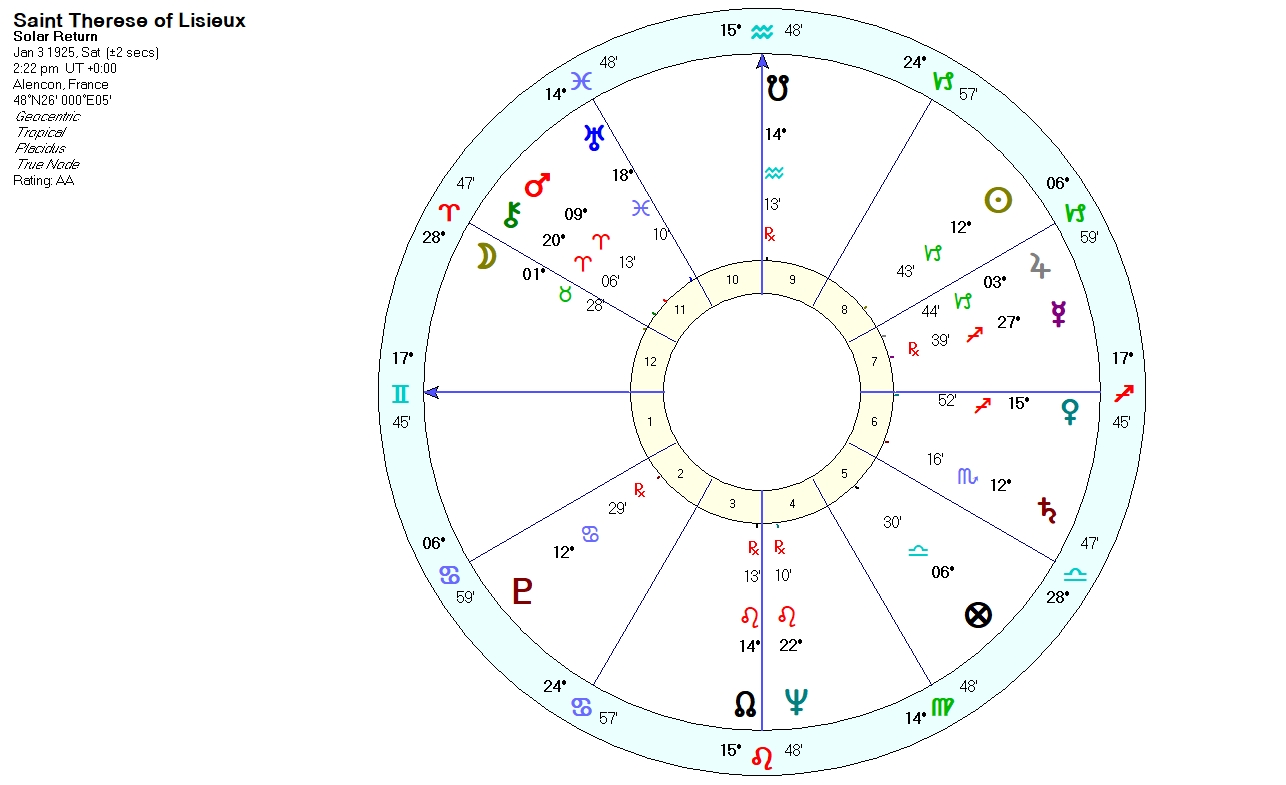
Therese officially became a saint on 17 May 1925 when she was canonized by Pope Pius XI. She died at age 24 and would have been 52 years old in 1925 when her canonization took place. Here is the Solar Return for the year of her canonization (1925):
Birthplace Solar Return for 1925 when Therese was declared a Catholic saint.
In the 1925 solar return (SR), Therese’s natal Asc-ruler Venus is angular and in partile sextile the the SR, MC, so we would expect this to be an important year for career and public standing. Interestingly, the South Lunar Node, Ketu, conjoins the MC. From a materialistic Western perspective, this conjunction might be considered unfortunate, indicating impending loss in 10th house matters. From an eastern spiritual perspective, the South Lunar Node Ketu is considered a symbol of renunciation, freedom from materialistic desires, spiritual liberation, and sainthood. In Hindu astrology, Ketu symbolizes moksha, or freedom the from cycle of life and death.
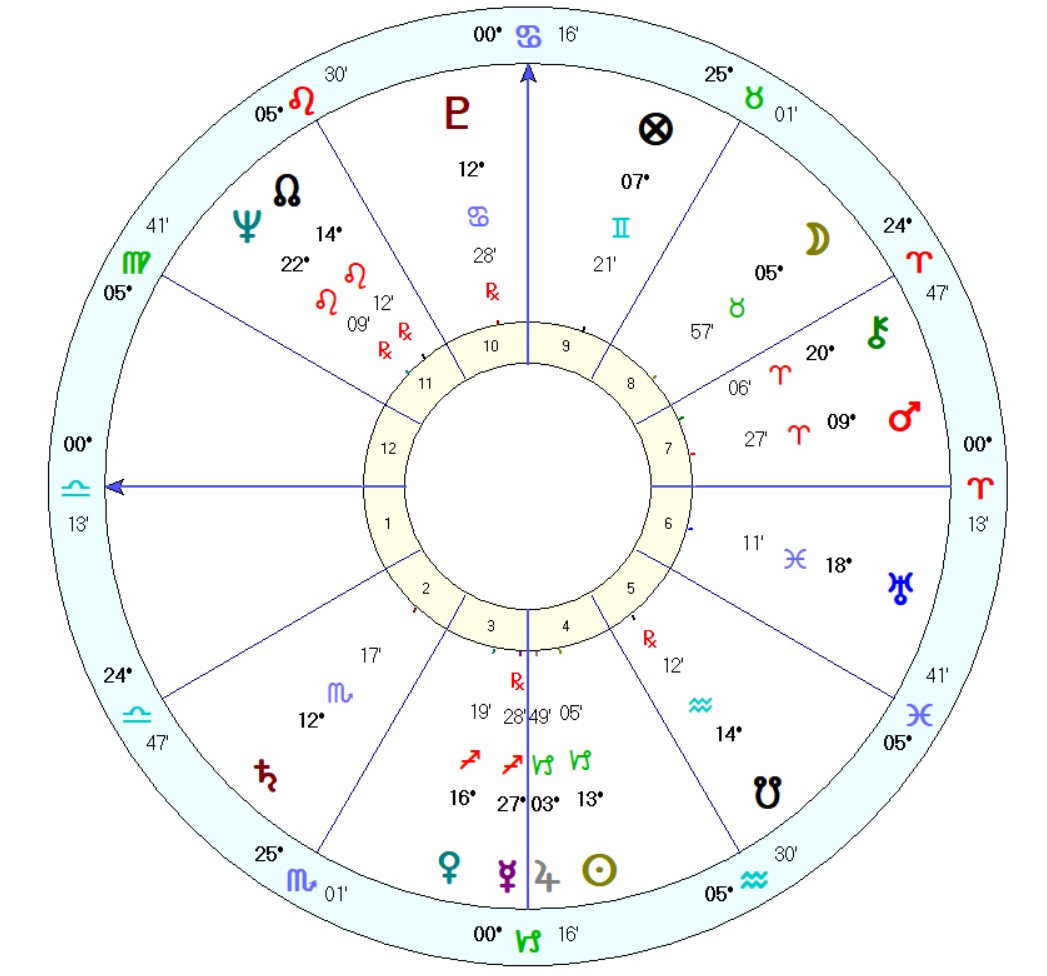
Therese officially became a saint on May 17th, 1925, which is 134 days after January 2nd, the date of her 1925 solar return. If we allow each day to represent 0.98564 degrees of R.A., as Morin suggests, then 134 days x 0.98564 = 132 degrees of Right Ascension on the Equator. From the tables in Solar Fire software, we see that the R.A. of the SR MC is 318d 16m, to which we add 132 degrees. The result is 450d 16m. From this, we subtract the 360 degrees in a circle and get the result 90d 16m R.A., which corresponds to 00 Cancer 16′ on the ecliptic.
In other words, on the day of her canonization in 1925, Therese’ progressed MC (at the rate of the mean daily motion of the Sun in R.A. per day) changes signs in the solar return from Gemini into Cancer, which is the natal sign on her Midheaven. A progressed change of sign of the MC or ASC is highly significant. In this case, a change of sign of the progressed SR MC involves her public status, and the change into Cancer, the sign of her natal MC, reinforced that signification. This change of sign of the SR progessed MC coincides with the date of her canonization.
Here is the Solar Return of 1925 readjusted to put 00 Cancer 16′ on the MC as the progressed MC (at the rate of the average daily motion of the Sun in R.A.) at the time of her canonization. The ASC and other cusps are recalculated based on the value of the progressed MC. Note how the progressed ASC (calculated based on the progressed MC) also changes sign to match the natal signs on the MC and ASC of her birth chart.
Therese’s birthplace solar return with MC progressed to 17 May 1925, the date of her canonization. Note how both the MC and the ASC change signs to the same signs on the MC and ASC of her birth chart.
Interestingly, at sunrise on the day of her canonization, the transiting Sun was at 25 Taurus, conjunct the 9th cusp of this progressed chart, and transiting Mercury, ruler of Gemini intercepted in the 9th house, was at 00 Taurus 08′, in partile sextile to the progressed MC at 00 Canner 16′. From an astrological perspective, Pope Pius XI picked an excellent day to proclaim Therese a saint.
Who knows? If Saint Therese happens to read this post from her abode in Heaven, maybe she’ll send me some roses.
A few years ago I did a post on the return of virtue in horary. Bonatti derived this idea from medieval Arabic texts, especially Abu Ma’Shar, and used the terms “return of virtue” and “return of light” in his own works. Recently, in an online forum, I came across a modern example of this principle in action. It was such an interesting example that I got permission from the author of the post, Nicolás Varlotta, and from the querent to discuss the horary chart here on my blog.
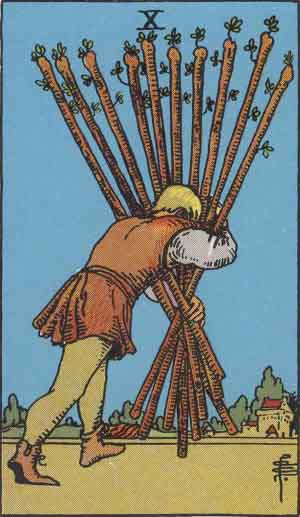
Bonatti gives a folksy example to illustrate the meaning of “return of light.” Suppose person A is carrying a heavy bundle of sticks which he needs to get to a certain location to accomplish his aim. Fortunately, along the way the exhausted person A meets a second person B, who may be able to take the sticks from him and carry then to the finish line. If B is in good shape and able to carry the sticks, A’s goal will be accomplished through the action of B. However, if B is weak and unable to carry the bundle, then B will RETUN the sticks to A who, in his exhausted state, will collapse under their weight. In this latter case, A’s goal will not be accomplished. “Return” occurs when the intended recipient of the light is either combust or retrograde. The outcome of the return depends on the status of the planet that initially sends the light, only to have it returned to him.
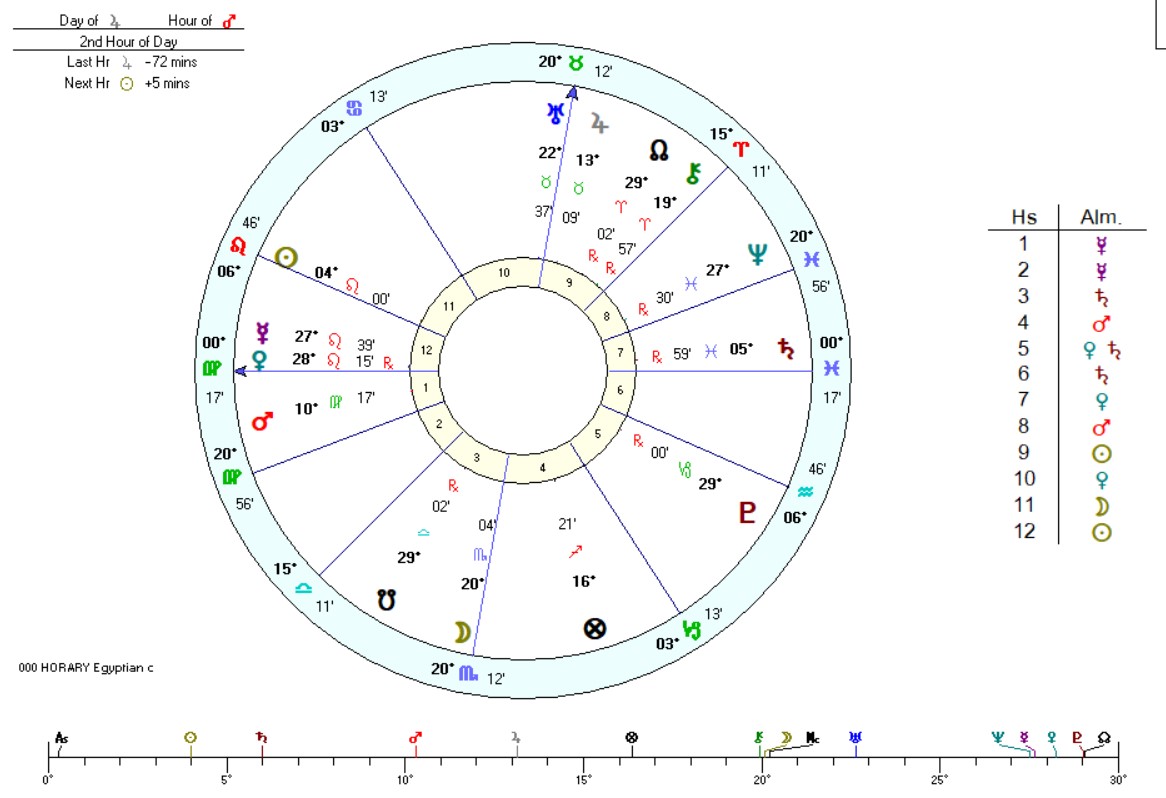
The Horary Question: the querent applied for a job and asked on July 27, 2023, at 8:30:27 CEDT in Eindhoven, Netherlands, “Will I get the job?”. Here is the chart:
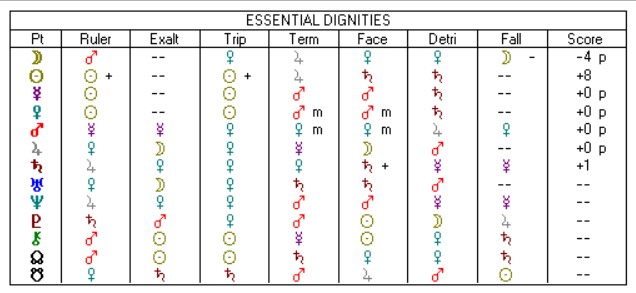
Dignity Table (Egyptian Terms)
With Virgo rising, Mercury rules the querent. Mercury is peregrine in Leo but is fortified by its proximity, within an orb of about 2.5 degrees, to the degree of the Ascendant, making Mercury an angular planet according to Ptolemy’s 5-degree rule and the method used by William Lilly. The Moon in 20 Scorpio can function as a co-ruler of the querent. As ruler and almuten of the 11th cusp, the Moon can also signify her hopes and wishes in the matter.
The 10th house represents the job. With Taurus on the 10th cusp, Venus signifies the desired job. Venus is also close to the Ascendant degree and thus angular by Ptolemy’s 5-degree rule. With Gemini intercepted within the Regiomontanus 10th house, Mercury could be a co-ruler of the job. In addition, because the Moon’s exaltation is in Taurus (on the 10th cusp), the Moon could also be a co-ruler of the job through this rulership by exaltation.
Seeing the mutually applying conjunction of angular Mercury (querent) to angular Venus (the job), the querent concluded from the horary chart that she would certainly get the job. A few weeks later, much to her surprise, she was notified that she would not be called for a second interview because there were other more qualified candidates for the job. This seemed odd to her because it occurred before the final date of the application period, and it was customary to wait until all candidates had been interviewed before notifying them of the outcome. She posted the horary in an online astrology forum, hoping to get an explanation for the failure of the chart to indicate that she would be turned down for the job.
Astrologer Nicolás Varlotta studied the chart and concluded that the querent would, in fact, be called back and would in the end get the job after this initial rejection. Noticing that Venus was Retrograde, he concluded that Venus would return the light she was sent by the approaching Mercury, a lighter and faster planet in this chart. Because Venus and Mercury were in Leo, he regarded their conjunctions to the Virgo ascendant as dissociated and, following the principles as explained by Abu Ma’Shar, he did not regard these planets as angular (strong), bur rather cadent (weak). Thus, he judged the return of light to Mercury as being unproductive.
Next, he considered the Moon (ruler of the 10th by exaltation) whose next contact is with Venus, which is still Retrograde and will therefore return the light of the Moon to the Moon. However, in this case, the Moon is strong and angular in partile conjunction with the 4th cusp. Thus, the Moon (the job) readily takes back its light and passes it on the Mercury (the querent), assuring that she will get the job after a delay or setback due to the Retrograde status of Venus.
My own view differs slightly from that of Nicolás. Since this chart is using quadrant houses, and both Mercury and Venus are so close to the Asc-degree, I would view them as angular (as I believe Bonatti would have) rather than cadent, even though the planets are in Leo and the Asc degree is in Virgo. Abu Ma’Shar does not allow out-of-sign conjunctions or aspects. However, Masha’allah said that “looking” is from sign to sign whereas “connecting” is from degree to degree. Conjunctions are bodily connections rather than aspects (looking). Also, I believe that Ptolemy would have regarded these planets as angular because they are bodily connected to the Asc and based on his 5-degree rule for determining strength of planets in his length of life technique. Then, Mercury, whose light has been returned to him by Venus, is strong enough to carry his light to achieve his goal. Next the Moon, which is carrying the light of benefic Jupiter (ruler of the 11th of hopes & wishes by exaltation) aspects Mercury, perfecting the matter. In addition, the Moon receives Jupiter in the sign of the Moon’s exaltation.
In the end, each of us would have come to the same conclusion, namely that the Rx status of Venus indicates a delay or setback related to Venus returning Mercury’s light to Mercury, but the next aspect of the Moon to Mercury brings the matter to perfection, though with some difficulty due to the square of the Moon to Mercury. Nicolás was correct in his interpretation. About a week after posting her horary chart, the querent received a phone call to come in for another interview. Finally on September 8th she was offered the job.
I wanted to post this example because I rarely see astrologers using the concept of return of light in discussing horary charts. It is interesting that even though both Nicolás and I use the concept, we differ somewhat in how to judge angularity in this chart. Other viewpoints, comments, or corrections are welcome. Please leave any comments below.
Recently several astrologers have speculated about the impact of King Charles’ diagnosis of cancer on his career. During a hospital procedure to address the king’s enlarged prostate, the doctors apparently found evidence of some type of cancer. The nature and severity of the cancer was not disclosed, prompting various astrologers (both tropical and sidereal), tarot readers, and psychics to declare that the reign of Charles III would be a brief one, soon to be succeeded by the reign of his son, Prince William. Given these ominous forecasts, I wondered what the Yogini dasa system, a powerful predictive tool, might reveal about Charles’ sidereal chart.
King Charles III sidereal chart with Vimshottari and Yogini dasa periods listed beneath.
The Vimshottari dasa system is fairly well-known, but many astrologers are less familiar with the Yogini system, which is also based on the Moon’s nakshatra at birth. The total duration of one Yogini cycle is 36 years, and there are eight Yoginis in each cycle. The Yoginis are assigned in order to the Moon (1 year), Sun (2 years), Jupiter (3 years), Mars (4 years), Mercury (5 years), Saturn (6 years), Venus (7 years), and Rahu (8 years), for a total of 36 years.
At birth Charles’ Moon was at 7 Aries 17′ in the nakshatra Aswini, which corresponds to the Yogini dasa Ma/Ve/Ma/Ra/Sa. The Mars mahadasa of Yogini has a span of 4 years. Charles turned 75 years old in November of 2023, and his cancer was diagnosed in January of 2024. Since each Yogini cycle is 36 years, at age 75, he has gone through 2 cycles (36 x 2 = 72 years) and is now in a 5-year Mercury period which began on 8 September 2022 and will end on 8 September of 2027. Interestingly, Charles’ mother Queen Elizabeth II, the UK’s longest-serving monarch, passed away on 8 September 2022 at Balmoral Castle. She was 96 years old at the time of her demise and had reigned for 70 years. As the eldest child of Elizabeth, Charles was next in line for the throne.
In the Yogini dasa system, King Charles’ current Mercury Yogini mahadasa period corresponds to the ‘progressed’ Moon traversing the Jyestha (“the eldest”) nakshatra. According to healingthewillows.com, “The word Jyestha derives from ‘Jye’, which means ‘the eldest and the most powerful’. Of all the 27 star sisters who are the Nakshatras, Jyestha is the eldest. The main star of this Nakshatra is the brightest central star of Scorpio, which is known as Antaris. This is the heart of the scorpion.”
It seems fitting that Charles became king as his Yogini ‘progressed‘ Moon was passing through Jyestha, whose meaning is the eldest and most powerful. The site astrosage.com describes Jyestha as follows (italics mine): “Jyestha Nakshatra, the eighteenth lunar mansion in Vedic astrology, exudes a powerful and transformative energy that holds a significant place in the cosmic tapestry. Ruled by the planet Mercury and positioned from 16°40′ to 30° in the Scorpio zodiac sign, Jyestha is associated with the mystical symbol of an umbrella, signifying protection and authority. Known as the ‘eldest‘ or ‘senior‘ sibling among the Nakshatras, Jyestha is often characterized by its commanding presence and regal demeanor. This lunar mansion is linked to the deity Indra, the king of the celestial realm, emphasizing leadership, power, and authority. Individuals born under the influence of Jyestha Nakshatra are believed to possess a natural inclination towards leadership roles and a strong sense of responsibility.”
Looking at the list of Yogini periods beneath his chart, we see that the cancer was diagnosed when he was in the Yogini dasa Me/Sa, which corresponds to the nakshatra Jyestha at the end of sidereal Scorpio. Essentially, this means that his progressed Moon (in the Yogini system) is conjunct natal Mars at the end of Scorpio. The progessed Moon (in the Yogini system) at the end of Scorpio is in the 8th house from the natal Moon in Aries. Mars rules Aries, which is the 6th house from Scorpio, and Mars occupies Scorpio, which is the 8th house from the natal Moon.
Viewing the chart from Scorpio as the progressed Lagna in the Yogini system, we see that Mercury lies in the 12th house and rules the 8th house, as measured from Scorpio. Mercury is significant because it is the Yogini mahadasa lord and also the planet associated with Jyestha in the Vimshottari system. Mercury is not a benefic planet for a Scorpio ascendant. In addition, Mercury is afflicted by an aspect from Saturn, which is the 8th lord of the natal chart and, as the natal 7th house ruler, is a maraka. The cancer was discovered during the Saturn subperiod of the Yogini Mercury mahadasa. In addition, the natal 8th-lord Saturn was transiting Aquarius, the natal 8th sign, when the cancer was diagnosed. Saturn entered Aquarius in January 2023 and will depart that sign at the end of March 2025; during this transit Charles is at high risk of a serious health crisis.. The Yoginia majadasa lord Mercury is sandwiched between Ketu and the Sun, which is also a maraka planet as ruler of the natal 2nd house.
[For those unfamiliar with marakas, which are associated with ill-health and potentially life-threatening conditions, wikipedia explains the concept of maraka in this way: “The 8th house from the lagna is the house of longevity; the 8th house counted from the 8th i.e. the 3rd house, is also the house of longevity. The 12th house counted from the 3rd and the 8th i.e. the 2nd and the 7th houses from the lagna, are the marakasthanas (the death-inflicting houses), and the lords of the 2nd and the 7th are designated as the principal Marakas (the inflictors of death or the killers).”]
All in all, it looks like King Charles is headed into some serious difficulties, which will likely include his health status. In mid-March of 2024, the king enters the Yogini Me/Ve subperiod, which lasts until March of 2025. From the progressed lagna in Scorpio (his natal 5th house), Venus rules the 7th and 12th houses, and, measured from the natal Moon, Venus occupies the 6th house which will be involved in the four eclipses during 2024, so the emphasis on 6th and 12th house issues remains prominent during the coming year.
Addendum, 22-March-2024:
On March 22, 2024, the Princess of Wales announced that she too was diagnosed with cancer and has been out of the public view because of her health condition. I wondered if this fact would show up i the king’s Yogini dasas.
In the king’s chart, his Yogini dasa period for 22 March 2024 is Mercury/Venus/Venus and his Yogini progressed Moon is in Jyestha in late Scorpio in his natal 5th house of children. As explained previously, Mercury is highly emphasized at this time.
The 5th house emphasis makes sense, given the fact that the Princess of Wales is the wife of his son William. Using derived houses, we see that William’s spouse is shown by the 7th from the 5th, or the 11th house (Taurus) of this king’s chart, which is ruled by Venus.
Venus also rules Libra, which is the natal 4th house of the king, and the derived 12th house of his son William (as shown in the king’s chart). Mercury, which is highly emphasized during this period, occupies Libra in the king’s birth chart and signifies the 12th (sadness) of his son William and the 6th (illness) of William’s wife.











 Anthony Louis - Astrology & Tarot Blog
